
Ports & Maritime
Observe the conditions where the work happens. Hyperlocal ground truth wind gust and weather monitoring for industrial container terminals and maritime logistics.
Terminal Wind & Quayside Safety
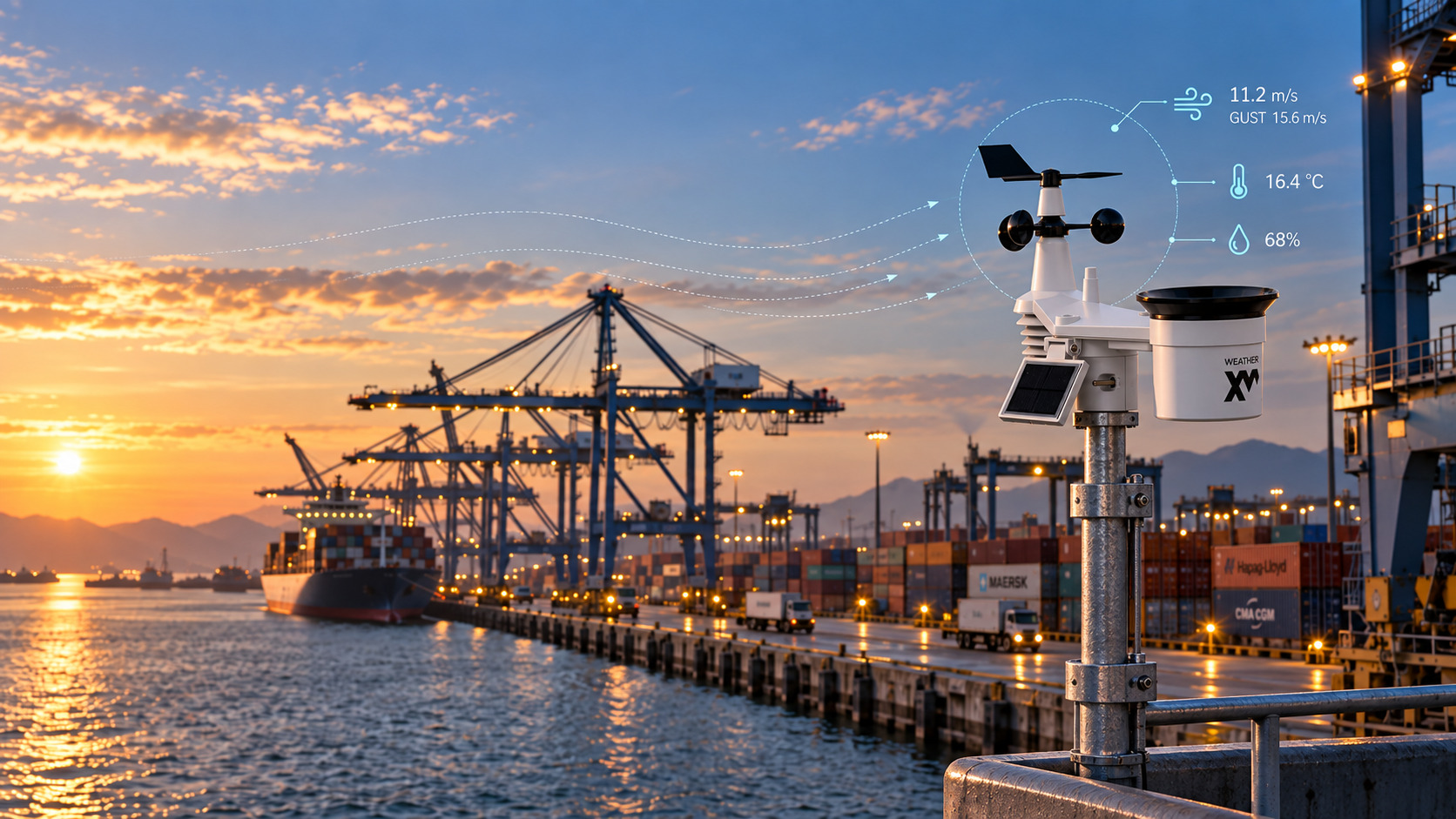
Observe the conditions where the work happens.
Wind speed and gust spikes at an exposed container terminal determine whether Ship-to-Shore (STS) cranes can safely handle 40-foot containers. The nearest airport observation describes a different microclimate, often by a critical margin.
Inland synoptic stations 10 km away often show calm conditions while sea breezes compress against breakwaters, generating sharp 25+ knot gusts at crane boom elevations.
WeatherXM deployed local weather observation at Piraeus Container Terminal (PCT), operated by COSCO Shipping Ports.
The installation brought continuous measurement directly into the working areas, giving terminal managers real-time empirical conditions rather than a speculative regional proxy.
Quayside Atmospheric Dynamics
Safety thresholds and operational continuity driven by true ground-level meteorological telemetry.
Boom & trolley wind limits
Crane and terminal operators define site-specific wind operating limits. Local wind and gust measurements give teams direct conditions at the working area to support safer operating decisions.
Inland vs quayside divergence
Airports situated 10 km inland register mild onshore breezes while sea-surface friction drops allow gale-force thermal sea breezes to strike berths without model forewarning.
Marine harshness hardening
UV-stabilized ASA polymer housings and sealed bearing assemblies withstand continuous corrosive sea salt spray and particulate exposure on breakwaters and mooring dolphins.
Deploy ground-truth weather at your facility
From berth and crane sensor installations to terminal operations dashboards and API feeds, we bring local ground truth to where decisions happen.