
A global observation network, built by people.
Thousands of independently operated weather stations measure local conditions around the world. WeatherXM brings those observations together, assesses their quality, and makes reliable ground truth available at scale.
Network snapshot: August 2026 · 5,900+ Active Stations · 4,300+ Synoptic Quality.
Dense ground truth requires physical infrastructure.
Forecasts can estimate conditions everywhere, but observations only exist where sensors have actually been installed. Traditional weather networks provide essential reference measurements, but cannot economically cover every location where local conditions matter.
WeatherXM adds affordable, distributed observations between those existing measurement points.
We complement reference networks; we do not replace them.
Reference stations, satellites and numerical models each do a job the others cannot. Reference stations provide century-scale continuity, rigorous standards and traceability. Satellites and models provide atmospheric breadth across the globe.
WeatherXM fills the spaces between reference stations with local ground observations, providing the hyper-local resolution required for energy grids, wildfire defense, ports and agriculture. The combined picture is stronger than any single measurement layer alone.
“WeatherXM is not just a collection of weather stations. It is a system for coordinating people, hardware, connectivity and quality to produce dense, reliable ground truth.”
Operating physical infrastructure globally requires aligning local caretakers with algorithmic verification and universal access. No single entity can dispatch technicians to hundreds of thousands of sites; the network coordinates independent station owners instead.
The physical world still needs people.
An observation exists only because somebody installed a sensor in the right place and kept it working. That is a physical coordination problem, not a software one.
The WeatherXM Network rewards qualifying data contributions, giving operators a reason to keep stations connected, well sited, clean and maintained over time. Rewards depend on contribution quality — not simply on owning hardware.
A weather sensor mounted next to an HVAC exhaust or blocked by trees produces misleading data. Real human caretakers select unobstructed rooftops, mount masts securely, keep solar panels and rain gauges clear of debris, and restore power when local outages occur. Automated Quality of Data (QoD) evaluates these factors and rewards operators whose stations meet rigorous physical standards.
Field operators deploying a WeatherXM station in Kenya. Real people choose sites, mount masts, and ensure continuous local operation.
WeatherXM uses decentralized token incentives to help operate its global people-powered observation network. The D2 Mesh station's local, direct, and mesh capabilities do not depend on a token, rewards, or the WeatherXM cloud. Users who want WeatherXM Network rewards can opt in separately.
Measure & Sign → Connect → Qualify → Deliver
How physical observations move from ground sensors to enterprise systems, researchers and applications.
Edge sensing
Sensors measure local weather and cryptographically sign observations at the source.
Any suitable network
Observations can travel over Wi-Fi, LoRaWAN, cellular, LoRa Mesh or other backhaul while remaining verifiable.
Quality of Data
Automated QoD checks physical plausibility, consistency and deployment context, assigning each contribution a quality score.
Useful ground truth
Qualified observations become available through Explorer, applications, APIs, datasets and forecast-validation services.
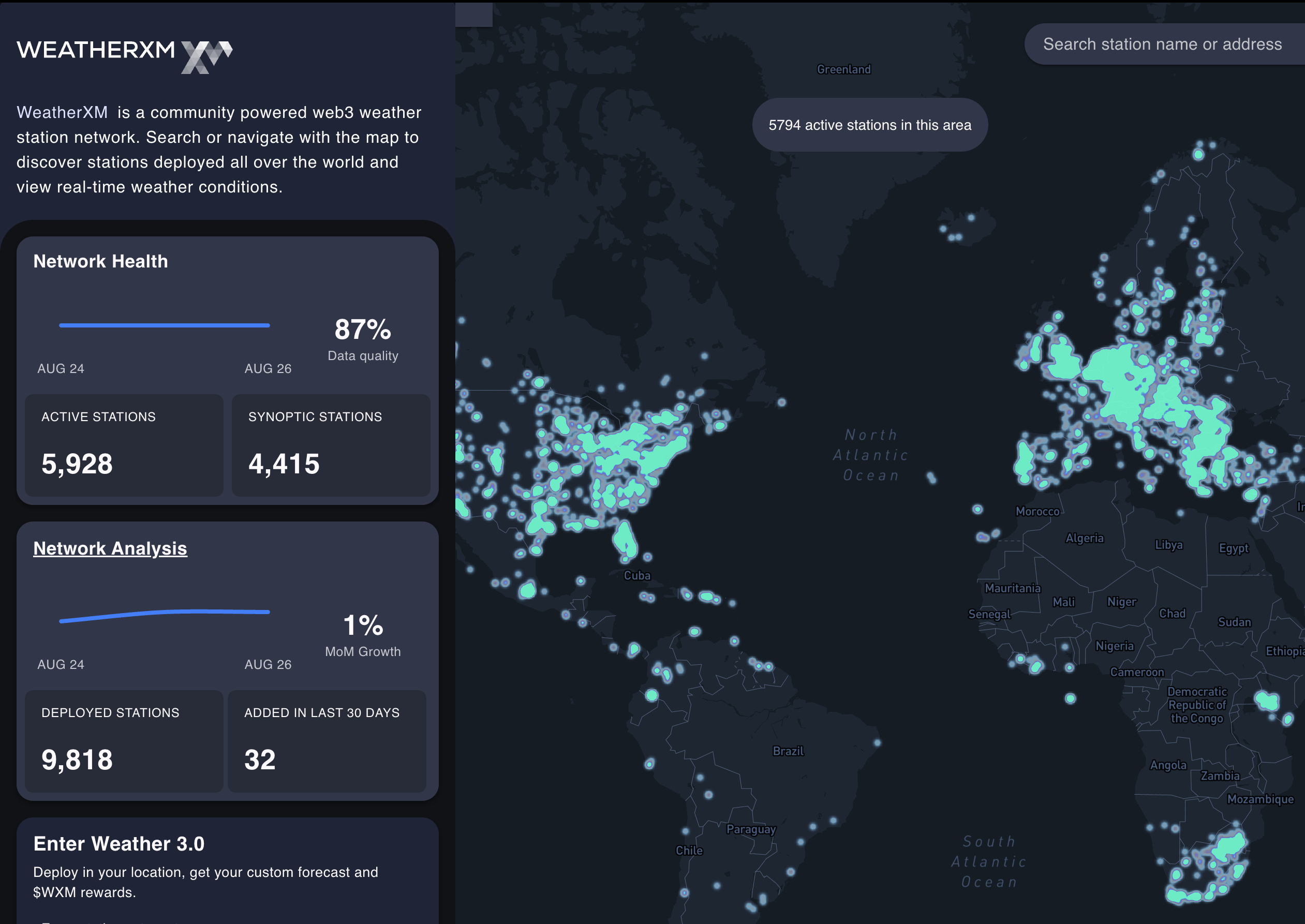
See where every observation comes from.
Explore stations, current conditions and historical availability on the public map. Coverage changes as stations join, leave or improve their deployment, so the Network itself remains visible.
Different places need different connectivity.
Urban sites may use Wi-Fi. Remote infrastructure may use cellular, LoRaWAN, mesh or satellite backhaul. Because observations are signed at the source, the transport network does not need to be trusted to preserve data integrity.
Urban & Home
Standard local residential and commercial broadband backhaul. Reliable, immediate edge delivery for urban environments.
Suburban & Campus
Long-range, low-power telemetry over public or private Helium / TTN gateways. Perfect for campuses, municipal parks and farms.
Independent grid
LTE-M / NB-IoT cellular connectivity with pre-provisioned global roaming. Autonomous power and comms with no local network setup.
Off-Grid Multi-Hop
Direct station-to-station peer mesh. Observations hop across nodes to reach an internet gateway or stay entirely local.
Beyond coverage
Direct-to-LEO orbital uplink developed with Lacuna Space. Ground truth from remote mountains, deserts, and maritime corridors.
How WeatherXM works alongside reference networks.
National meteorological agencies and airport AWOS stations maintain calibrated standards over decades. WeatherXM does not seek to duplicate those expensive facilities — it fills the blank spaces between them.
National reference stations
High-capital, professionally maintained meteorological stations (NWS, DWD, ECMWF WMO stations). Gold-standard accuracy, but spaced 30 to 150 kilometers apart.
Satellites & numerical models
Geostationary and polar-orbiting satellites, atmospheric soundings, and physics-based numerical weather models (GFS, ECMWF IFS, HRRR). Continuous global estimates, but limited surface-level hyper-local resolution.
WeatherXM Observation Network
Dense, edge-signed ground stations deployed by businesses, landowners, and communities. Fills microclimate gaps in complex terrain, valleys, urban canyons, and renewable energy assets.
A network with separate roles.
The independent WeatherXM Network Association manages Network participation, rewards, governance and Network Dataset licensing. WeatherXM AG develops WeatherXM hardware, software and commercial weather services.
Network participants
Install hardware, provide site access and power, choose optimal installation locations, maintain clean sensors, and supply verifiable ground measurements.
Network association
An independent non-profit entity that oversees network protocol specifications, algorithmic reward rules, token distribution mechanisms, and open data licensing.
WeatherXM AG
Commercial technology company that designs and manufactures stations, builds mobile and developer tools, maintains enterprise APIs, and provides enterprise weather solutions.
Participate in the Network
Whether you want to deploy ground sensors or build mission-critical operations with verified data, WeatherXM provides the infrastructure.
Want to contribute observations?
Deploy a WeatherXM station and participate in the Network. Track your local conditions, maintain station quality, and earn network rewards for qualifying data contributions.
Need the data?
Use qualified observations through our applications, REST APIs, machine-native x402 endpoints, and historical forecast archives.